

Updated November 2026
CPAs are trusted advisors. That means they’re often the first to hear when a client is thinking about a sale or restructuring. By having a pulse on sector valuations, a CPA can engage in those conversations with confidence. To help, Viking is committed to providing market-leading transaction insights. For this update, we analyzed our 100 most recent transactions with at least $1.5 million in revenue, all closed between 2024 and October 2026. Based on that data, we’re sharing a refreshed look at four industries shaping today’s lower middle market and what it could mean for your clients.
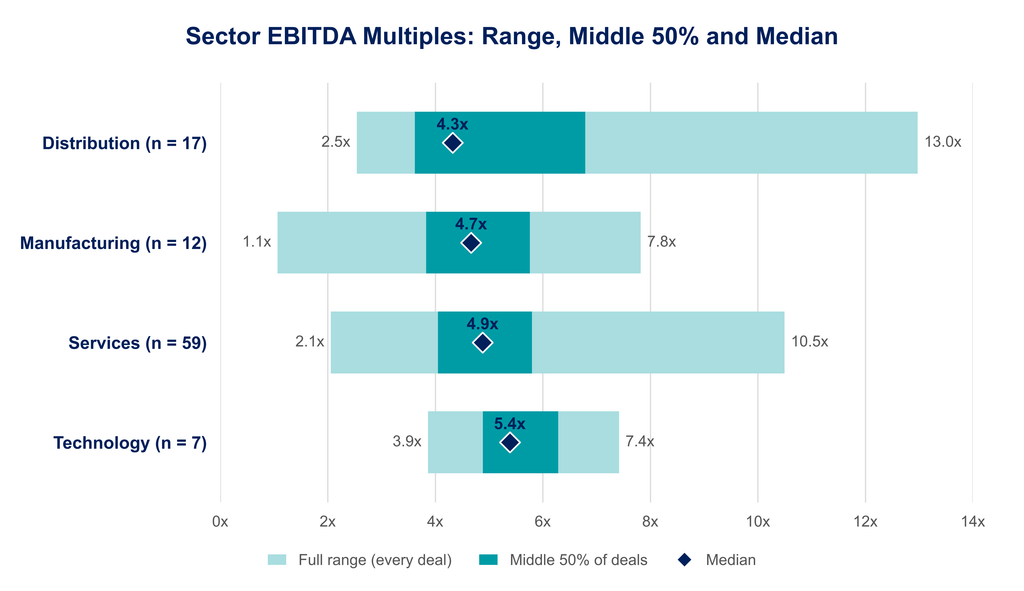
Of our 100 most recent transactions, 95 mapped to the four sectors we’re highlighting. Across those 95, median EBITDA multiples ranged from 4.3x in distribution to 5.4x in technology, with manufacturing at 4.7x and services at 4.9x. Individual transactions varied much more widely, from 1.1x to 13.0x.
Sector Snapshot
The chart below illustrates the range, middle 50%, and median EBITDA multiples across four key sectors: distribution, manufacturing, services (including healthcare), and technology. This side-by-side comparison provides a snapshot of each sector’s market positioning.
Market at a Glance
Within every sector, the spread between the lowest and highest multiples typically reflects how much risk a buyer sees in the business. Common factors include transferability (whether the company can run without its owner), customer concentration, recurring revenue, growth and margin consistency, and the quality of financial reporting. The sector summaries below highlight the factors that matter most in each industry.
Distribution Sector
Distribution recorded a median EBITDA multiple of 4.3x and the widest multiple range, from 2.5x to 13.0x. For CPAs, that spread highlights the importance of looking beyond an industry average. Customer concentration, supplier relationships, and the company’s role in its customers’ operations are useful starting points when assessing how closely a client resembles a potential comparable.
Manufacturing Sector
Manufacturing transactions ranged from 1.1x to 7.8x EBITDA, with a median of 4.7x. That wide spread makes a single sector multiple a limited guide for an individual business. When helping clients prepare for a valuation, CPAs can add important context by examining margins, equipment investment needs, customer concentration, and the consistency of earnings.
Services Sector
Services, including healthcare, covers a diverse group of businesses with different operating models. That makes comparable selection especially important: a healthcare practice, a project-based service company, and a business with recurring contracts may share a category while presenting very different opportunities to a buyer. CPAs can help clients evaluate the durability of revenue, staffing requirements, and how much the business depends on its owner.
Technology Sector
Technology recorded the highest median EBITDA multiple in our sample at 5.4x and the highest minimum multiple among the four sectors at 3.9x. Those figures provide a useful reference point, but the technology label alone offers limited guidance for a specific company. Revenue mix, customer retention, intellectual property ownership, and ongoing development costs help put a potential comparable in context.
What This Means for Your Clients
The findings offer several practical talking points for conversations with business owners:
- Use sector multiples as a starting point. The ranges in the chart show how widely outcomes can vary within an industry. A business-specific valuation requires a closer look at earnings, operations, and relevant comparable transactions.
- Look closely at the quality of earnings. CPAs can help owners distinguish repeatable operating performance from one-time income, unusual expenses, and other items that affect how buyers interpret EBITDA.
- Start preparing before a sale is near. Reliable financial reporting, documented adjustments, and a clear explanation of revenue and margin trends give owners a stronger foundation for valuation and buyer discussions.
- Invest in high-quality financial reporting. Maintaining accurate, timely monthly financial statements prepared on an accrual basis can reduce perceived buyer risk, increase confidence in reported earnings, and potentially support a higher EBITDA multiple. CPAs can play an important role in helping business owners establish these practices well before a sale.
Helping Clients Capture Value
CPAs often help owners connect their financial performance with their long-term plans. Current transaction data can make those conversations more concrete, whether a client is considering a sale, preparing for succession, or simply exploring what the business may be worth.
Viking Mergers & Acquisitions works alongside CPAs to provide transaction insights, valuations, and strategies that maximize opportunity. Together, we can help business owners realize the full potential of their hard work.
About the Data
Figures reflect Viking’s 100 most recent closed transactions with at least $1.5 million in revenue (2024–October 2026). Of those, 95 mapped to the four sectors shown; the remaining five fell outside these categories and are excluded. EBITDA multiples are calculated as total purchase price divided by Adjusted EBITDA. The chart shows the full range, middle 50%, and median observed in each sector, which are not a substitute for a business-specific valuation. Total purchase price includes any seller notes and earnout consideration, before adjusting for the buyer’s financing structure. Adjusted EBITDA is earnings before interest, taxes, depreciation, and amortization, normalized for owner compensation, one-time items, and other non-recurring or discretionary expenses.